Nonferrous metal smelting is an important source of heavy metal pollution in the environment. As point sources of heavy metal emissions, smelting enterprises often create clear horizontal differences in the levels of heavy metal contamination in surrounding areas. Meanwhile, residential buildings with heights of around 100 m are increasingly common in urban areas, yet little is known about how heavy metal contamination varies with building height.
To investigate the vertical and horizontal distribution patterns of heavy metals in windowsill dust of high-rise residential buildings in a nonferrous metal smelting area, the “Ecology and Environmental Remediation” team collected 189 dust samples from windowsills on floors 1–31 in six residential communities located 4–10 km from a nonferrous metal smelter. The concentrations of heavy metals - including cadmium (Cd), chromium (Cr), copper (Cu), lead (Pb), manganese (Mn), nickel (Ni), and zinc (Zn)—were analyzed. The study innovatively introduced the concept of the vertical concentration gradient (VCG) and combined Pb isotope analysis, cluster analysis of heavy metal concentrations at different heights, and ecological risk assessment to elucidate the spatial distribution patterns of heavy metals in windowsill dust in the smelting area.
The main findings are as follows: (I) Nonferrous metal smelting primarily resulted in the accumulation of Cd, Cu, Pb, and Zn in dust. Overall, the concentrations of these elements decreased gradually with increasing height, with an average decline of 1.03% per floor (i.e., VCG = −1.03% floor⁻¹), although deviations from this trend were observed in some cases. (II) Cluster analysis indicated that in areas farther from the smelter, the sources of heavy metals in windowsill dust on lower floors were more diverse, with road traffic identified as a possible additional source. (III) The contribution of smelting activities to heavy metals in dust gradually decreased with increasing distance from the smelter. (IV) In most residential communities, the ecological risk associated with heavy metals in dust decreased with increasing building height.
These findings deepen the understanding of the spatial distribution of pollutants in nonferrous metal smelting areas and provide important references for assessing health risk exposure of residents in high-rise buildings, as well as for better environmental management and urban planning in similar areas.
The results were recently published in Environmental Pollution, entitled “Vertical and horizontal distribution of heavy metals in high-rise building windowsill dusts in a nonferrous metal smelting affected city” (DOI: 10.1016/j.envpol.2026.127938). The lab work of this research was conducted by associate Professor Qing Zhao, with the advice by Professor Liping Li. Professor James A. Ippolito of Colorado State University, USA and several other members of the Joint Lab also contributed to this work.
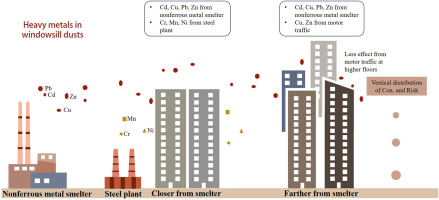
Graphical abstract
Drafted by Qing Zhao, reviewed by Liping Li, approved by Dongjin Wan




 地址:河南省郑州市高新区莲花街100号
 邮编:450001
 邮箱:hjgcxy@haut.edu.cn
